
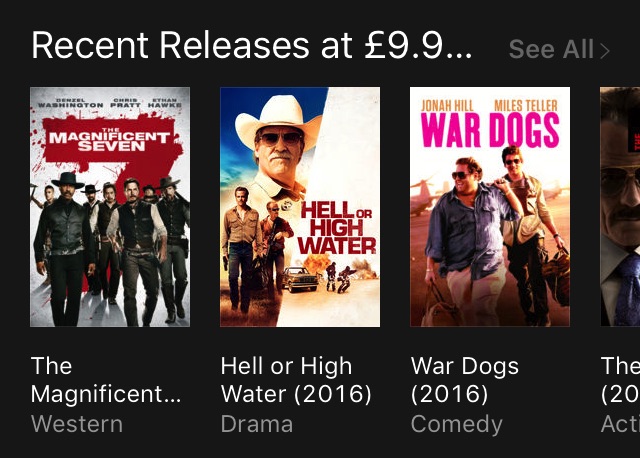
It dawned on me recently that mst media I now purchase is temporary and that a lot of it is in a place I am unaware of.
For example, when I purchase films they sit on an iTunes server, or an Amazon server, or a Google server. I don’t know where half of them are, but I have the complete West Wing purchased which required me to plug in the Apple TV to watch the episodes. Most of the time I have the Roku plugged and I have found myself looking through various devices many times to find the film I want to watch.
It isn’t actually there in a physical sense, but I can access each film with the right device. The question is for how long?
Amazon, Apple and Google are huge and secure brands, but so were Woolworths, Our Price and so many companies that no longer exist. This makes my purchases temporary from the moment I buy them because they are tied to the seller. When I buy a DVD (I never do) it is not tied to anything. I can just pick it up and play it, and of course the same applies to CDs and vinyl.
Does it worry you that your purchases could one day be inaccessible? That you have no way to physically save them and that we may end up in a time when everything (films, TV shows, music) is streamed through monthly subscriptions? When that happens, even the word ‘temporary’ offers too much longevity.
Categories: Articles
 McGST
McGST 
Different media have different historical “save” modes. Like, you definitely owned and cherished books and their re-readability, but you more often saw films in the theater or shows on tv or rented a tape. (Music was in between, maybe you owned records or maybe you mostly enjoyed the radio.) Some of that’s driven by if you expected to come back to the piece much (music, yes, a movie, maybe maybe not, a book… well, good for reference even if you don’t make the time to reread.)
For my mildly narcissistic life, the critical thing is the metadata; the little db I’ve kept up with pretty much all media I consume (You can peruse some of the annual summaries at http://kirk.is/tag/media ) More important than the media is my history of the taking in of it.
For the media itself, the questions become 1. Will I watch this again (or show off to friends), 2. if it’s not placed in my at-hand collection or goes away because a company dies or changes policy, how hard will it be to find again…
Movies, music, and books tend to have redundant ways of getting back to ’em – sometimes copyright issues bork it, but a lot of things you can either scrape up on youtube or find on amazon if you don’t mind paying. One medium that, as a hobbyist/collector, scares me as it goes virtual and more beholden to corporate policy: video games. Unlike the other formats, many games are platform specific. If the release of those becomes purely virtual and streaming based, and the company holding your virtual library changes its mind or goes away, well, that’s Game Over…
LikeLike
I am always concerned that either a company will go under or they will decide to change the rules and anything I have purchased that is stored there is no longer accessible. So I like to keep my digital media on an external hard drive with an off-site backup at my son’s house. But fthen there’s the format issue.
If I purchase electronic media, be it movies, TV shows, music, or books, I resent being forced to a particular format or device. So I take what steps I have to when it makes sense for me. For example, I prefer iBooks as a reader on my iPad but rarely purchase iBooks themselves because I can’t use anything else but the iBooks app. What happens if another ebook reader app comes along that I prefer. So I purchase Kindle format from Amazon, there’s rarely a price problem, and convert them to epub to read on iBooks.
For movies that I rent, it doesn’t matter, because I’m planning to only watch them once. If I think that I’ll watch more often, which is rare, I’ll buy the Blu-ray version and either download the digital copy or copy and convert the Blu-ray version to mp4. I know that the digital download probably has DRM, but I can always convert from Blu-ray if I have to.
LikeLike
Yeah, backups. Actually it’s one reason I don’t rely on strictly cloud-based solutions for backup. (Dropbox splits the difference nicely though)
For a while I shunned music from iTunes, but now I’m trusting m4a files are about the same, now that they’ve dropped DRM.
Re: books… I don’t know as much about conversion as you, so I assume Kindle is kind of locked in. But the category has kind of moved to the same as movies – ok with one time use, or if I think sharing/reuse is in the cards I might order a physical copy.
LikeLike
Book conversion is easy using Calibre, which is donationware. The only common format it can’t handle is ibook.
LikeLike
For now, everything that I’ve owned and somehow lost I’ve managed to get back again somehow. I store my favourite movies and music on hard drives.
I wouldn’t want to rely having my purchased goods being in control of someone else to have access to.
LikeLike
This seems, for me, to be an extension of the vinyl album discussion earlier. When I decided to digitize my music collection, it wasn’t for quality, but for convenience. It is heady carrying around hundreds of album on my phone and choosing what I want to hear.
But I don’t trust the cloud. I have my database of 15,000+ songs on my laptop and a backup drive. Yet, that raises another problem. Except for my music, I really don’t need a home computer. I typically only use it to manage the songs that I want on my phone.
The cloud would solve that for me, but I don’t trust it. I can’t wait to get a phone with enough memory to carry my complete collection. I had an iPod Classic, but it’s now toast. (Thank goodness for my back-ups.)
LikeLike
Y’know, too, it’s not just trust of the cloud – it’s all the services and attempts to arrange my digital life, especially music and photos.
I’m at the point where any system for me has to have an underpinning of “files in directories” that I can back up to a local harddrive. So like for iTunes, I back up the music files but also have it spit out that library.xml , so in theory I could reconstruct anything I needed to.
LikeLike
Sounds like we’re all of a similar mind. I use the cloud or other companies’ servers to transfer files but not to store them. I don’t use iPhotos or Photos because I don’t want someone else telling me how to organize or where to store. Even though I use the iBooks app on my iPad to read, I have a separate ebooks folder and copy books to the iTunes Books folder on my Mac which is where I add them to the iBooks library. Basically I don’t trust iBooks to move things to somewhere else. Currently it just copies them. As for iTunes music, so far it seems to keep things visible and in a reasonable structure. But if it ever changes, I’ll have a separate folder for that too.
LikeLike